

The motor controller for our little CitiCar has arrived! This is what will allow us to get the most efficiency out of the motor. The new controller will send 48 volts letting the motor operate at its full power, but pulsed based on how far the throttle is pressed. This gives you a large amount of torque at any speed.
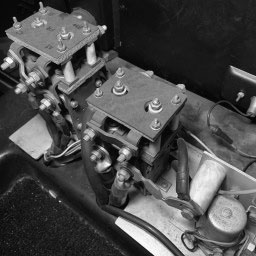
The original motor controller is a contact switch that provides an uninterrupted supply either 48, 24, or around 18 volts to the motor. The same voltage is applied in both forward and reverse.

The first benefit happens when you press the pedal into the the first step. The muti-voltage speed control provides a low voltage by sending 24 volts through a large nichrome resistor. This resistor is often used for heating elements in toasters and deep fryers. Much of the energy is wasted as heat in the first voltage step. With the new motor controller, the full 48 volts is sent to the motor, but in very small pulses. Energy is used more efficiently rather than thrown away as heat.


The next feature is with the throttle itself. The CitiCars have a three step throttle. There are three contact switches that close or open based on how far you press the accelerator pedal. I’m replacing the CitiCars throttle switches with a potentiometer, known as a pot box. This lets me gradually control the speed. With the existing setup, I have to keep switching between each switch position to control speed so I don’t go too fast or too slow.
When I press the throttle now, the motor immediately jumps with a lot of torque to get to the new speed. This wastes energy. The new motor controller will ramp up the speed gradually in a more efficient manor. It also has the ability to control how many amps are supplied to the motor so that I don’t blow a fuse. The original CitiCar controller lets the battery directly connect to the motor, letting the motor draw as any amps as it needs until a fuse is blown, or the load demand is decreased.
With the new controller, a complex switching of the batteries between a 48 volt and 24 volt configuration is no longer needed. The nominal voltage of the battery bank is simply 48 volts, all the time.
Next Steps
I don’t have everything just yet. There are still a few things that I need before I can switch over to the new setup. Until then, I’ve started reading over the schematics. I have planned out how to wire up the batteries to the motor and controller. I need to measure out new battery cable lengths and size of terminals to fit everywhere.
I purchased an F-N-R (Forward and Reverse) switch to swap the motors connections when traveling in reverse. Some owners just use the original CitiCar contactor for this. Rather than rely on old hardware, I purchased a new switch rated with the amperage that I needed along with suppression diodes. I also ordered a contact switch with a diode and pre-charge resistor.
I was messing up on the coil voltage when ordering switches. I’m working with two voltages – 12 volts and 48 volts. 48 volts is for the motor, but the voltage is also stepped down to 12 volts to control lighting, switches, and accessories. It gets confusing when ordering equipment because it’s not clear which voltage to choose from, since the equipment itself also works with two separate voltages. In the end, make sure its the accessory voltage for the coils (12 volts in my case), or you’ll need to use relays to control your relays.

Voltage
Alltrax does provide a cheaper controller that works with up to 48 volts. However, I was told that the motor I am getting would be capable of running off of 72 volts as long as there was plenty of forced cooling. In that scenario, I wouldn’t need to buy a new controller – just a new set of batteries. Batteries don’t last forever. If there is one thing to know, it’s that voltage equals speed. The more volts you have, the faster you can go.
In other news
- D & D Motor Systems responded that my motor will be ready to ship in 2-3 days
- D & D Motor Systems has shipped out my contactor switch
- I’ve been purchasing misc stuff from AliExpress
- Hazard Light Switch
- GPS Speedometer
- Switch panel for a racing car engine (race mode – alltrax user mode)
- Flashing relay switch
- 12v socket TPMS
- Car Bluetooth MP3/USB/SD/FM/AUC decoder board audio modules
- Current meter battery capacity monitor
- Two more 48v Chevy volt battery modules have been shipped
- I’ve filled out a return/replacement request for my portable EVSE
- The lithium charger might be drop shipped sometime at the end of the week
- Waiting for Zero J1772 adapter with C-19 plug from Tuscan EV
- EV Drives is processing my order for a F-N-R switch, and has updated the coil voltage
- I was able to connect to the Alltrax controller via USB
- A cassette adapter arrived. Plans are to pull out the head and throw it into an 8-track tape.
- A few magazines arrived with CitiCar articles in them, and posted on the Magazines page.
 The Chez