
| TLDR; | Gas | Electric |
| 1 Gallon @ 25 miles | $2.00 | $0.78 |
Quite often people consider how much it costs for a gallon of gas. When it comes to electric vehicles, we often think of how much it costs per mile. We know the rate of our electricity, and it doesn’t often fluctuate day-to-day like most gas stations. However, it may cost more during the “peak” hours, but it is always a known price, and rarely changes.
To get the cost per mile, we measure the distance we have traveled, and the amount of energy it takes to recharge, or “top off”, the batteries. An odd quirk regarding batteries is that they discharge at different rates based on how much energy is left. Therefore a price per mile would be less if you only drive for a short distance, compared to a longer trip that drains the batteries further. Making several stops on a long trip to recharge will consume less energy than making one stop.
To measure the amount of energy to recharge, I use a Kill A Watt meter. I plug my charger into the meter, and it monitors how much energy is used while charging the vehicle. Most energy monitors measure in kWh with a precision of two decimal places. When we try to determine the cost of energy per mile, this precision is fairly limiting in how accurate our numbers can be.
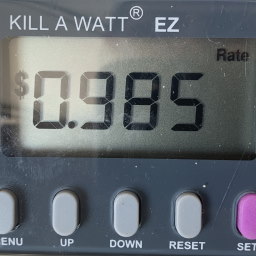
I can be a stickler on the precision of numbers sometimes when it comes to spreadsheets to track energy and costs, especially when it comes down to calculating small numbers. Hacking the precision of the meter is possible, if it also calculates the cost. Rather than enter the exact rate per kWh, I move the decimal to the right. Instead of entering my rate as $0.098, I enter $0.985. I even get an extra decimal for a better accuracy on cost! Although the meter still displays the same kWh, the total cost is measured at a higher precision that can be calculated to get a more accurate reading of the energy used.
In the following table, you can see the precision of the cost per mile is greatly affected from 3.18¢ per mile, to 3.137¢. It may not appear like much of a difference, but its a difference of one cent for every 100 miles driven. Okay, maybe a penny isn’t that much of a difference.
| Value Of | Reading | Calculation | Actual |
|---|---|---|---|
| Rate | $0.985 | $0.985 / 10 | $0.0985 |
| Cost | $2.75 | $2.75 / 10 | $0.275 |
| kWh | 2.8 | $0.275 / $0.0985 | 2.7918 |
| Miles | 8.8 | ||
| Cost Per Mile | $0.0312 | $0.275 / 8.8 | $0.0313 |
| Wh Per Mile | 318 | 2.7918 / 8.8 | 317 |
- Actual Cost = cost / multiplier
- $2.75 / 10 = $0.275
- kWh = cost / multiplier/ rate
- $2.75 / 10/ $0.985 = 2.7918
- Cost per Mile = cost / multiplier/ miles
- $2.75 / 10 / 8.8 = $0.0313
- Wh per Mile = cost / multiplier/ rate / miles
- $2.75 / 10 / $0.985 / 8.8 = 317
So, is this more accurate? Does it matter? It’s all about having fun with numbers and getting a general idea of what is going on.
Comparing Electric to Gas
Now that we know our price per mile, we can use it to compare with other fuels. Take note that the average price per mile depends on the car, how the car is driven, engine, load, terrain, traffic, price of fuel, and more… this little exercise is to determine if the cost difference is significant.
Today I can purchase a gallon of gas down the street for $2.009. The average car can get 25 mpg. That’s an average price of eight cents per mile. I have a hybrid vehicle that gets a little over three cents per mile, and an SUV at just under 17 cents a mile. My battery powered CitiCar gets a little over three cents per gallon, on par with my hybrid car.
Is it really cheaper?
Quite often, you’ll hear others further justify the cost of electric due to less maintenance such as oil changes, emission tests, and less moving parts breaking down. Take this with a grain of salt as there may be other costs associated, or greater costs for repairs, fees, taxes, insurance, subscription services, etc.
The greatest cost of an electric vehicle (currently), is its batteries. It’s cheaper to replace a leaking gas tank than to buy a new set of batteries. In that scenario, it may be ideal to sell if for spare parts, haul it to the junk yard, and buy a new car instead.
Battery Explosions!
Yes! But… cool guys don’t look at explosions! Legacy battery technology with floating lead-acid batteries ran the risk of not only catching fire, but highly corrosive causing skin burns, and off gassing hydrogen and oxygen. Lead acid batteries have made improvements to being sealed and valve regulated to use in any position, and later into absorbed glass mat (AGM). Today’s EV batteries are made up of different materials such as lithium with more safe guards in place that make driving next to a vehicle carrying 20 gallons of highly flammable gas for an internal combustion engine that constantly lights a little bit of it on fire seem like a death trap. Maybe I’m going too far exaggerating there…
Disruptive Electric Vehicle Evolution
Prior to the past ten years, the maximum distance between charges was severely limited, and brought about the term, “Range Anxiety”. I often limit my trips in the CitiCar to go no further than five miles at most. Hybrid vehicles came out to increase efficiency using a combination of batteries, regenerative breaking, and a gas motor. Plug-in hybrid electric vehicles (PHEV) often run 20-60 miles on batteries only, and then switch over to gas once the capacity has been drained. Battery electric vehicles have improved recently, with some vehicles going sixty miles on one charge, and more recently, 300 miles.
Today there is quite a bit of technological evolution when it comes to battery electric vehicles. Battery capacity, costs, charging, safety, and energy density are all improving, as well as electric motor efficiency, charging speed, aerodynamics, weight, and vehicle handling to the point that artificial intelligence is setup in some cars to drive on their own.
 The Chez