
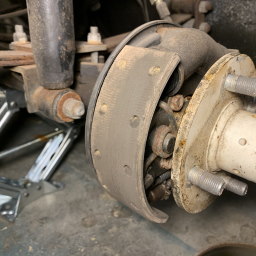
It seems the brakes are engaged on the car, and the break light is always on.
I jacked up each tire and tried to spin them individually. The two front tires were the most difficult to turn, especially at certain positions of the rotation. I went about tackling the front driver side tire first.
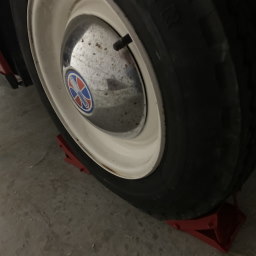
I have some small wheel chocks used for ATVs and trailers. I placed them at the drivers rear tire and disengaged the parking break.
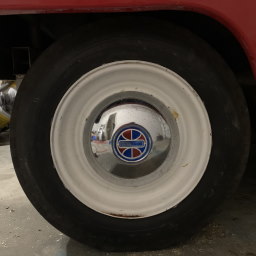
It bugged me that the tire stem for this tire was on the inside of the car.
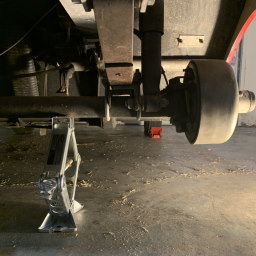
The car sits low to the ground. I found that a scissor jack is small enough to get under the car. The jack needs to be placed far enough from the tire to gain access to the back of the breaks.
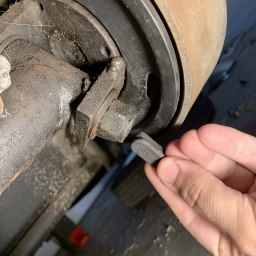
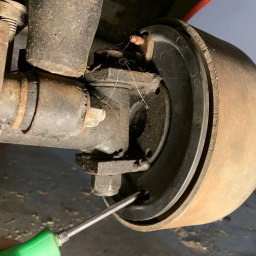
From here, I was able to reach in with a screw driver to tighten and loosen the tension of the brake shoes against the drum.
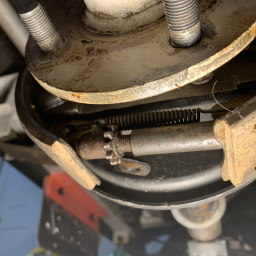
From this point, I was able to loosen and tighten the brake shoes how I saw fit. I was trying to get the wheel to spin freely on its own, and ensure the wheel didn’t spin when the parking brake was engaged.
I tightened the brake shoes until I couldn’t move the wheel by hand. I then let back a little until I could spin the wheel. I then engaged the parking brake. Unfortunately, the wheel was still able to be spun freely.
I then tightened it up just a little so the wheel didn’t move. I disengaged the parking break, and the wheel still wouldn’t move.
From these steps, I have deduced that the parking brake does not control the front wheels, the parking break isn’t engaging, or that it has a separate way of being adjusted.
I decided to loosen the breaks up to allow the wheel to spin.
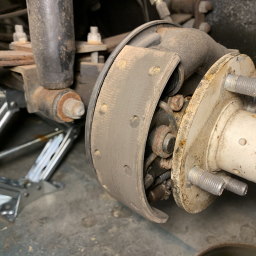
When spinning the drum, there was resistance against the break shoes at different parts of the rotation. I loosened the brakes and took the drum off for further inspection.
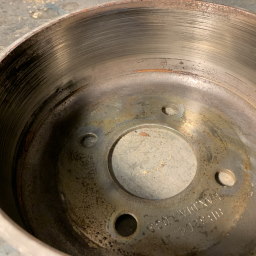
Scratches could be seen on the inside of the drum where the shoes had rubbed against the walls. I’ve gotten response from others that the brake shoes themselves have a lot of miles left to drive before they need to be replaced.
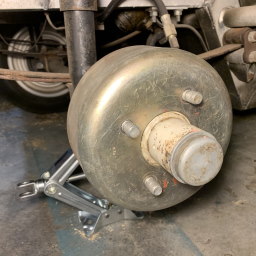
It was time to put the cover back on. Out of curiosity, I decided to try putting the drum on the bolts in four different orientations. I found that one orientation in particular allowed the wheel to spin the most freely without as much rubbing. I threw the lug nuts onto the drum to help orient it when tightening up the brakes, but I found that it had a harder time rotating with the pressure.
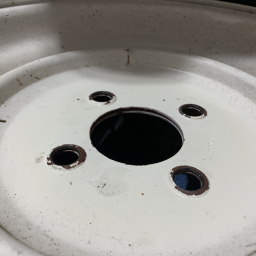
The rim was next. The location of grease and tire stem had me thinking the rim was on backwards. Furthermore, the inside of the rims have embossed edges, where the opposite side has wells. I believe the wells should be facing towards the drum to reduce the tension of the lug nuts against it.
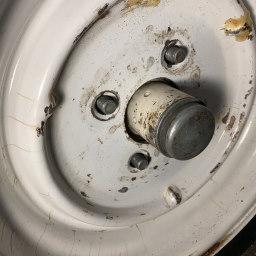
Putting the wheel on the opposite direction than it came off left me with a tire stem facing out. The tire still spun more freely prior to taking it off. One little problem is that the hub cap has no tension at all and simply falls off the rim.
Front Passenger Tire
I was able to jack up the car and adjust the brakes. I was able to start spinning the tire, but something still was still touching at certain parts of the rotation. It is suspected that an impact wrench was used to tighten the lug nuts. It took a lot of effort, jumping onto the tire iron, to loosen the lug nuts without moving the car. Chocks on the back tire couldn’t compete, and the steering wheel was turning. This was certain to put too much pressure against the drum itself.
The drum was removed to reveal a nice set of hardly-worn brake shoes without much break dust. The inside of the drum had an area that was pitted quite a bit. The axle spun freely on its own. An optimal orientation was found to place the drum onto the axle. The tire went back on, lug nuts tightened, and attach the hub cap.
 The Chez