
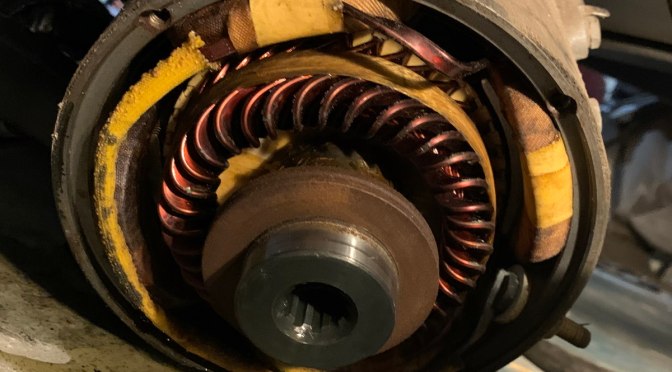
I’ve been in contact with D&D Motor Systems, trying to upgrade the motor I have with something that is a bit stronger, speedier, and possibly with some regen capability.
With all of the information I had available, it just wasn’t enough without taking the engine off and going in for a look inside. I reluctantly went ahead and pulled the engine off today.

It was a bit of a long drawn out process, disconnecting cables and wires, photographing and making videos of what went where. The hardest part was at the tail end where it was time to take the motor off.
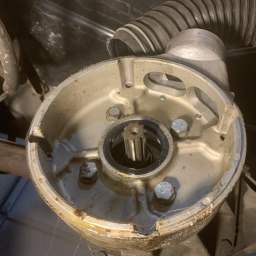
At one time, I had three separate jacks that I was using. Two were scissor jacks, and I also had a trolley jack. With all of this, I still felt as if I didn’t have the correct equipment for the job. Wiggling the motor out was a fairly difficult process. After some time, the motor gave way and oil spilled out of the axle.
I now had a motor standing free on some jacks. I wasn’t able to move it back any further since the speedometer connection was still on the back. I started lifting it, but it felt as if it was catching on something. The motor is very heavy, I started to set it down, but the scissor jacks fell over. I did my best to lower it to the floor.

I took a few measurements, counted 10 teeth, and then I was off to work out the gear ratio. I found a clip that I could put onto the shaft and setup my camera to look directly at it. I then went to the back of the car, marked each tire with a line of chalk, and spun both tires 10 times, calling out each revolution. It turned out to be 68.3 revolutions, which works out to be a gear ratio of 6.83:1.
With a gear ratio of 6.83:1, my assumption is that there are 41 teeth meeting up with 6 – witch would actually be a ratio of 6.83:1, where it has an infinite number of trailing 3’s. I thought at least one of the numbers on the axle would have indicated the ratio, the number of teeth on the shaft, and what type of shaft it was.
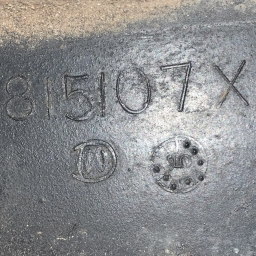
This ratio was not recognized on the CitiCar wikipedia page. It listed earlier models with a ratio of 7.125:1, and later models with a ratio 5.17:1. The page also indicated there was a “hilly” option on the transitional cars with a higher ratio than 5.17:1 at a cost of speed, but didn’t specify what it was. A NASA article (NASA TM X-73638, October 1976, page 32) had mentioned a different ratio of 6.83:1 on their car, and a maximum speed of 32 mph.
Once I realized my gear ratio matched the one that NASA had, I was certain what the hilly ratio was, and that I had it. I’ve been in a similar situation trying to get up to 33 on level ground, but just recently found that my speedometer is four miles too fast as well.
I went ahead and added the new ratio for the hilly option on the Wikipedia CitiCar page and referenced the NASA article. I may start making additional changes over time. I’ve got a treasure trove of documents, books, and links pertaining to the history of the CitiCar.
It’s been a long day. I’m tired. My goal has been completed. I’ll put the motor back on tomorrow. I had purchased a few items prior to replace the axle gear oil. I just wish I had played it a bit safer and be prepared for oil to come out. I suspect someone may have put too much inside. I’ll end up flushing it all out. I have no idea if the weight matches what I have, or how old it is.
Maximum Speed

Let’s have a fun exercise to determine the maximum speed at which everything is rated.
The motor is rated for 4000 rounds per minute (RPM)
The gear ratio is 6.83:1
At 4000 RPM, tires would spin at 585.65 RPM.
I’m using 125R12 tires (the original stock size) with an overall diameter of 20.39 inches. The radius is 10.195 inches. Solving the the circumference (2 π r), I get roughly 64.06 inches.
One tire revolution would consist of traveling 64.06 inches. In a perfect scenario, this is only possible without any load, car, or gravity to make the tire… smaller.
585.65 revolutions per minute would travel at 37,516.739 inches per minute.
| Unit | Per Minute | Per Hour |
|---|---|---|
| Inches | 37,517 | 2,251,004 |
| Feet | 3,126 | 187,584 |
| Yards | 1,042 | 62,528 |
| Miles | 0.59 | 35.53 |
The combination of the motor, axle, and tires only permits the vehicle to drive at a maximum speed of 35½ mph.
Keep in mind, this doesn’t take a loaded radius, air pressure, or rolling circumference into account.
 The Chez