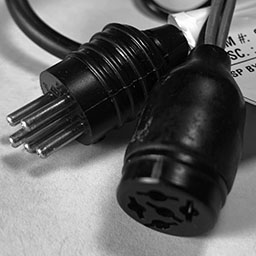
The remote control cable for a Kodak carousel projector arrived for the CitiCar today. I was able to confirm through others that the 5-Pin male plug would fit into my radios 5 pin female plug. Sure enough, I mated the two together and they had no problems.
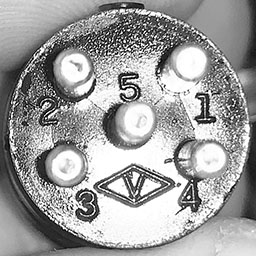
Pins on a Kodak slide projector cable plug
The projector uses this plug with a remote control to control forward, reverse, and focus. The wires in the slide projector plug are only 22 AWG (0.65mm thick). This is because the projector used more voltage on some pins with less need for amps. I was questioning myself if the wires could handle the power that the radio needed to draw though them.
Testing continuity with a voltage meter
I pulled out my voltage meter and switched it over to measure continuity. I listened for a beep as I held one of the test leads on a wire, and tapped each pin on the plug.
The plug is fairly new and looks a bit modern. Each pin on the molded plug is numbered clearly. In addition, there is a little nub at the top to help keep track of what direction you are holding the plug in. This made it quite easy to map each color to a pin number. As for the car radio, I had previously used a red paint marker to mark the pin for power.
Pin
Color
1
Black
2
Red
3
White
4
Brown
5
Yellow
Map wires to each pin
The next step was to plug it in and start identifying how the various colors were used in the radio. I quickly found out that the red and black wires mapped to the same colors on the radio for power and ground.
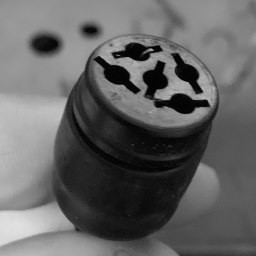
The female plug on the radio
The radio only has four wires leading into its plug. The center pin is not connected to anything.
The speaker wires were a bit tricky to figure out. One of them wasn’t working at all. I tried swapping the speakers with each other to determine if the speaker was still working, or perhaps I didn’t have a good connection.
Car Speaker
It turned out that instead of a bad speaker, or failing to wire it up properly, the radio itself wasn’t sending a signal. Using the radios balance knob, I was able to determine that the radio wasn’t sending anything over the green wire to the right speaker. The grey wire was for the left speaker.
Projector
Remote Color
Pin
Radio Color
Function
Focus
Black
1
Black
Ground
Forward
Red
2
Red
Power
Reverse
White
3
Grey
Left Speaker Positive
Rack solenoid
Brown
4
Green
Right Speaker Positive
Ground
Yellow
5
(none)
Map wires from the remote control wire to how the radio uses them
I traced the green wire inside of the radio, which turned into a thin orange wire that went to a circuit board. From here I ran along the trace until I came to a electrolytic capacitor. I’ve often heard tales where others have had to replace capacitors to get things to work. I decided it was time to stop.
RCA adapter with screw terminals.
The next time I focus on the radio, I’ll screw the left speaker into two separate RCA screw terminal adapters. This will let me wire it up to the CitiCars left and right speaker from the same channel for a mono sound. I’ll also replace the wires on the projector plug with something thicker. It feels like a potential fire hazard.
Products
WGCD 20 PCS Phono RCA Male Plug to AV Screw Terminal Plug Connector Audio Video Adapter
Remote Control Cable 5 Pin Male (Round/Kodak) Cutoff 5 Wires 22 Gauge 12 ft
I feel this is a bit absurd, but I figured out how to wire the 8-Track car radio into an Android head unit for the CitiCar. It’s “old vs new” where the two radios work together in epic proportions.
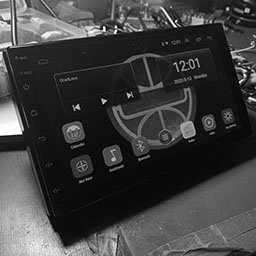
The Android Car Radio Head Unit
The 8-Track car radio can pickup both AM and FM, where the Android tablet is only compatible with FM stations. I like the older way of doing it instead of the digital radio app that they provide on the tablet.
Made in China
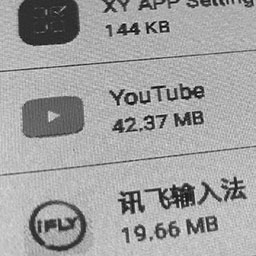
The Android tablet is strait out of China. Going under the hood, I was running into odd phrases and in some cases, a full screen of Chinese writing without an ounce of English.
Chinese app iFLY
I had to uninstall apps such as one that had a logo of iFLY that kept changing my settings to use a Chinese keyboard at each boot-up. I still need to go over all apps to verify how much I trust them.
As a programmer, there were a few things of note that I did when digging around in the app. Here are a few of the default passwords I gathered, and things I did to get more access to the system.
Developer Mode
Android Settings About vehicular platform Click build number 9 times
Developer Options
OEM unlocking: On
Factory Settings
8888
Engineering test debugging
26959910
Bluetooth: Car BT
0000
Accessing the Android system for configuration
Wiring Harness
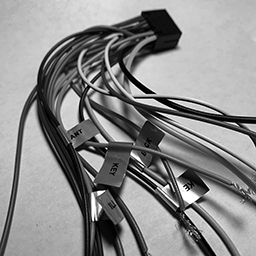
Not all wires are labeled on a radio harness
I learned quite a bit about wiring with most modern cars today. The CitiCar itself does not have a radio. It is often displayed as an option that you can have added onto the base models price.
Being inexperienced with wiring a car radio, I was confused when I saw a bunch of wires, where only some of them were labeled, and even then – the labels didn’t make much sense to me.
I couldn’t even power the device on when I hooked it up. I saw it draw power for about minute, followed by a trickle. I learned that the thin red wire is wired to the key so that the device powers on when you turn the key to the accessory position.
I found a ton of videos online describing the standard colors for radio speakers, illumination, amp, antenna, and battery power. I still had some trouble with other wires. Here is a list of information I have learned.
First, I’m assuming that it needs a 25 amp fuse for both the speakers and the device/GPS/camera. The four speakers outputs are rated for 45 watts each, for a total of 15 amps on a 12 volt system. The device itself has its own 10 amp fuse plugged into the back.
Wire
Label
Connection
Switch
Thick Yellow
POS
Battery Positive
25 Amp Fuse
Thick Black
NEG
Battery Negative
Thin Red
ACC
Battery Positive
Accessory Key
Orange
ILL DIM
Battery Positive
Headlights or Dimmer Switch
Pink
BACK
Battery Positive
Reverse Gear
Blue
ANT
Power Antenna
Blue +Stripe
AMP
Amplifier
White
Speaker Positive
Front Left
White +Stripe
Speaker Negative
Front Left
Gray
Speaker Positive
Front Right
Gray +Stripe
Speaker Negative
Front Right
Green
Speaker Positive
Rear Left
Green + Stripe
Speaker Negative
Rear Left
Purple
Speaker Positive
Rear Right
Purple +Stripe
Speaker Negative
Rear Right
Orange +Stripe
KEY
Battery Negative
Steering Wheel Control 0-5k Ohm
Brown +Stripe
KEY 2
Battery Negative
Steering Wheel Control 0-5k Ohm
Wires on a 12 volt car radio
Steering Wheel Controls
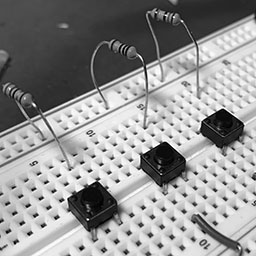
Breadboard of universal steering wheel controls (SWC)
I’m not quite sure if it was the most fun, but it was the most interesting experience I had trying to figure out how the key wires worked. These are for your universal steering wheel controls (SWC). I learned that it’s a very simple system that looks at a resistance value up to 5k Ohms between either “key” wire and the ground wire, which triggers the device to execute a command mapped to a specific resistance (or close to it).
After playing around with various resistors, I found the device was able to determine the difference between the following:
1
39
82
150
18
56
100
…
27
68
120
5,000
SWC Resistance Sensitivity
I gave up by time I got to 150 as it seemed as if it could tell the difference between all of the last few resistors. The lower differences in resistance are the hardest for it to determine. At minimum, it is advised to step at least 20 ohms between each of your control values.
I may look into making a 3D printed device sometime to control the device, or buy a generic wireless steering wheel add-on that can be strapped onto the CitiCar steering wheel.
Of special note is that the two key wires appear to have the same behavior. Putting the same resistor value on both wires, the system will react the same way. My understanding is that this second wire is to allow passengers in the vehicle have control over some of the radios functionality as well.
8-Track Audio to RCA
RCA Male Plug with Screw Terminal
I picked up an adapter with an RCA Male Plug on one end, and a screw terminal on the other. I was able to connect some wires from the 8-Track into the screw terminals. Then I simply plugged in the RCA jack into one of the RCA female plugs on the Android tablet to be available as an audio input device.
I’m still waiting for my remote control cable for a round Kodak projector 5 pin male plug to insert into the 8-Track radios plug. It will be easier to take the radio out of the car for maintenance in the future.
Pyle 2-Way 180 Watt Car Speaker
I purchased a pair speakers a few years back when I built a bar-top arcade. I went ahead and found the same speakers and purchased two sets for the CitiCar. I don’t know where I’ll put them just yet.
The last part of the equation was to hook up the speakers. The quality was much better than my test speaker. They are adequate for the car itself. The media tablet only puts out 45 watts to each speaker. 180 watts is more than enough to handle the power in such a small space.
Custom Logo
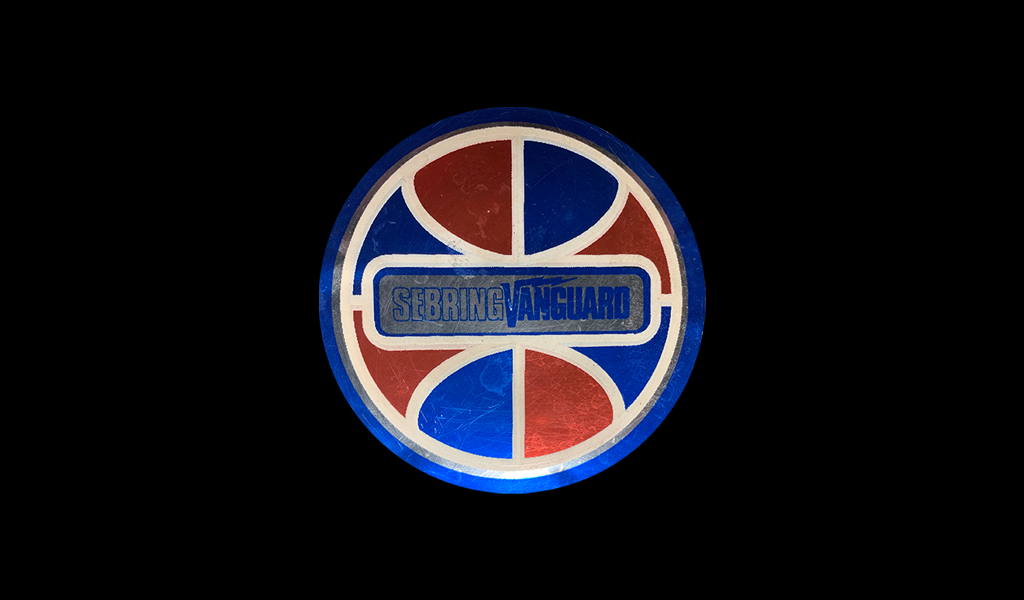
I customized the display to show the Sebring Vanguard logo from my CitiCars hubcap during boot-up. After much troubleshooting, I found that I needed to use a 1024×600 pixel bitmap using a color depth of 24 bits. I used the same image for my wallpaper as a PNG file.
PNG file for Sebring Vanguard wallpaper * Convert to 24-bit BMP format to use as a boot-up image
You can also set the boot animation. I’m often running into a wall trying to set it up. I’ve just recently got something working.
I’ve made a file that conforms to the bootanimation format. The latest thing that I did seems to have fixed the problem. I created a folder path to “/oem/media/bootanimation.zip”. I then went into the logo animation settings to select it. I’m a bit confused over it, but hey – progress. It may also be due to having the device in developer mode as well.
Version Notes
The device itself seems to be an unmarked/unbranded item. The plain brown cardboard box itself is marked as “Made in China” FCC CE and recyclable logos on opposite sides. It has no other details except a small label A2628KT on the top. Mucking about under the hood, I found a few things of interest, mostly regarding version numbers. The device itself thinks everything is up to date.
Android
9.1
XY Auto
3.1 (8227L)
CAN Pro
3.0 (8227L)
MCU
3.1 (8227L)
Model
8227L_demo
Security Patch
November 5, 2017
Kernel
3.18.22 gangll@zx-PowerEdge-R730 #5 Thu Oct 17 10:26:20 CST 2019
Build Number
android-trunk-m0.AC8227L-V1.0
Box Sticker
A2628KT
Version information behind
Video
I made a breakthrough this weekend setting up an 8-Track to play through an android head unit. Now I have Bluetooth, GPS, radio, backup camera, steering wheel controls, and more!
Product List
Double Din Car Radio GPS Navigation Android Head Unit 7″ HD Touch Screen Indash Car Stereo Support Dual USB, AUX in, Bluetooth, WiFi, FM, Mirror Link with Rear Camera (2G+32G)
讯飞输入法 (iFLY App)
8-TRACK AM Vintage car audio RADIO original
Joe Knows Electronics 1/4W 1% 86 Value 860 Piece Resistor Kit
MCIGICM 10pcs Breadboard 830 Point Solderless Prototype PCB Board Kit Protoboard MB-102 for Arduino DIY Electronics kit
WGCD 20 PCS Phono RCA Male Plug to AV Screw Terminal Plug Connector Audio Video Adapter
Remote Control Cable 5 Pin Male (Round/Kodak) Cutoff 5 Wires 22 Gauge 12 ft
Universal Car DVD GPS Player Wireless Remote Controller, Steering Wheel Remote Control Button for Car Navigation DVD / 2 din Radio Bluetooth Steering Control
Kalevel 120pcs Breadboards Jumper Wires Male to Female Jumper Wires Male to Male Jumper Wires Female to Female Jumper Wires Kit Long Ribbon Cable 20cm (m-m, f-f, m-f)
KAIWEETS 10PCS Electrical Alligator Clips with Wires Test Leads Sets Soldered and Stamping Jumper Wires for Circuit Connection/Experiment, 21 inches 5 Colors (10 PCS)
Peter Frampton Music
Update
I got “Car Settings” to do something. I’m beginning to think that KEY 1 and KEY 2 should be connected to the CAN bus. Here is how to make car settings show a screen for your specific car (If you had a Raise Electric Car JRYG-M2)
Car Settings \ Factory Settings [8888] \ Protocol Settings \ Raise \ Electric Car \ JRYG-M2 (can ID 1034001)





 The Chez